In this article
A wagging tail is a small faux-fur tail with a motor in its base that swings it side to side when you press a remote, tap it, or make a noise. Mounted on the back of a car, truck, scooter or motorcycle, it turns an ordinary rear end into something people wave at. The tail itself is the easy part. Whether it stays a good idea depends on three things: where it sits, how it attaches, and whether you can set it off without taking your attention off the road. Get those right and it is a cheap, removable bit of personality that needs no drilling.
How does a wagging tail work, and what do you actually get?
Inside the base sits a small motor and a rechargeable battery. The motor swings a fur-covered tail, and something has to tell it to start. Across the seven listings behind this guide, the triggers are a wireless remote, a sound or voice sensor, and a tap sensor. Some tails offer only the remote; others offer all three. They were listed between roughly $16 and $30.
These are decorations, not vehicle equipment. A tail does nothing for visibility or safety, which is exactly why the rest of this guide is about where it goes and how it is held on.
Is a tail only for cars?
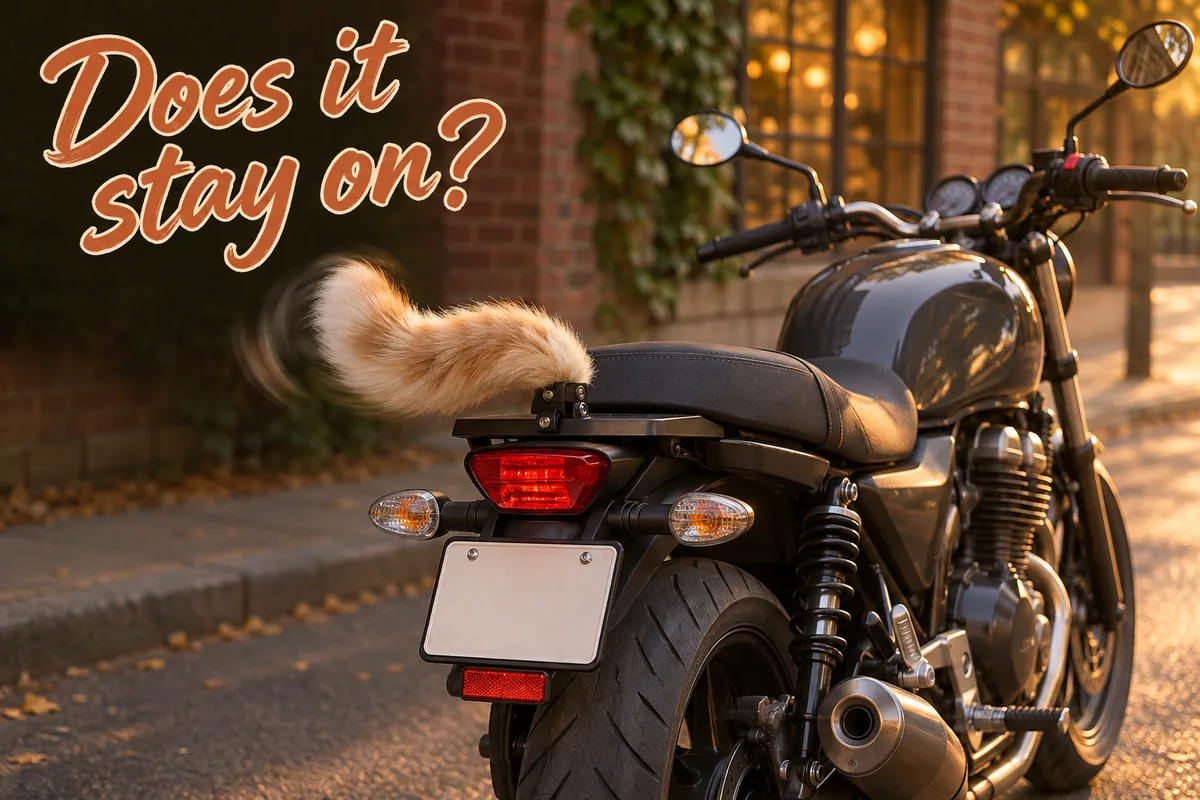
No. The listings describe cars, trucks, RVs, scooters, motorcycles, bicycles and, in one case, wheelchairs. Motorcycles are the tightest fit, because there is far less rear surface to work with and far more going on back there: a plate, a taillight, reflectors, a passenger, luggage and a hot exhaust.
One more honest note about the evidence. Only three of the seven tails have any buyer ratings, five written comments in all, and none include photos. The rest are brand-new listings. So what follows leans on what the listings say, labeled as such, plus ordinary mounting sense.
Where can a tail go without blocking anything important?
Start with what the tail must never cover or swing in front of. Walk around the back of the vehicle and list the things other drivers rely on:
- The license plate, including its corners and any state name or registration sticker.
- Brake lights, taillights and turn signals.
- Reflectors, including the small ones on the sides of some motorcycles and trailers.
- The rear window, camera and parking sensors on a car or truck.
- On a motorcycle, the rear wheel, chain or belt, exhaust and the passenger's legs.
There is no rule written for tails specifically, so the useful question is whether the tail interferes with something that is regulated. Plate rules differ by state; Minnesota's statute, for instance, requires plates to be displayed so that their view is not obstructed. On the equipment side, a 2009 NHTSA recall record shows that aftermarket motorcycle saddlebags were recalled because they covered the rear side reflectors. If a bulky accessory can create a problem that serious, a fluffy tail swinging across a plate can too. Check your own state's rules for plates and lights.
Judge the spot by the whole swing, not the tail at rest. Mount it temporarily, have a helper start the wag, and watch from directly behind and from the side. If the fur passes in front of the plate or a light at any point, move it.
What about a motorcycle?
Look for a flat, rigid surface with open space around it: the tail section behind the seat, the lid of a top case, or the handlebars if the mount includes a clamp. Keep it away from the exhaust, because faux fur and heat do not mix, and keep it clear of the rear tire. If it goes on the handlebars, make sure it does not touch the levers, mirrors or your view of the gauges.
One of the listings says its mounting hardware is made for vehicle surfaces or handlebars and that the same tail suits bicycles and wheelchairs, which makes it the most flexible option on a small vehicle.
How do you attach a tail without drilling or damaging the paint?
The listings describe three ways of holding a tail on, and each suits a different surface.
Adhesive pads
One listing describes a quick-release mount with adhesive pads meant for a clean, dry, flat surface, with no drilling or permanent change. One buyer says it took about five minutes on a hatchback. Pad adhesive grips best when you give it a fair start:
- Wash and dry the spot, and wipe off wax or polish with a cleaner the pad instructions allow.
- Mount at a mild temperature rather than on a cold or sun-baked panel.
- Press firmly for the time the instructions give, and wait before the first drive.
- If the paint is fresh, repainted, chipped, wrapped or coated, ask the shop or try the pad in a hidden spot first.
When you want it off, go slowly. Warm the pad gently with a hair dryer on low, peel it back at a low angle, and clean any residue with a product made for automotive paint. Pulling hard is how paint comes off with the pad.
Suction cup with a lever
One buyer of a small remote-control tail describes cleaning the trunk surface, pressing the suction cup, locking the lever and plugging in the battery in under 90 seconds, with no tape residue. Suction holds best on smooth, non-porous surfaces. Textured plastic, matte finishes and wraps may not seal, and constant vibration can work a suction cup loose, so a smooth trunk lid is a better match than a motorcycle.
A detachable base
The third approach splits the tail from its base. The base is stuck to the vehicle once, and the tail clicks on and off. That matters more than it sounds, and it comes up again in the charging section.
Will it stay on at highway speed and in the rain?
One listing says its mount stays stable even at highway speeds. That is a seller's claim, not a test, and none of the buyer comments describe highway driving. Treat any tail as something to check rather than something to trust.
Give the mount a firm tug after installing it, again after the first short drive, and again after a week. Look for lifted pad edges, a loosening lever or a base that rocks. Take the tail off before an automatic car wash, since brushes and high-pressure jets are hard on anything stuck to paint.
Weather is the other open question. One listing calls its fur wear-resistant and suitable for decorative outdoor use, but none of the listings supplied states a water-resistance rating. Assume splashes at best, keep it out of heavy rain and standing water, and let wet fur dry before you charge it or store it.
Which control mode works best while you are driving or riding?
The best answer is the one that does not make you look away from the road. A remote is easy to use from a car's driver seat. On a motorcycle, a small remote is awkward with gloves, so wag it at a stop or hand the remote to a passenger. Better still, set it going before you pull out.
A tap sensor is for a parked vehicle: a photo, a meetup, a curious kid. A sound or voice sensor responds to whatever it hears, and one buyer said their kids love yelling at a tail to make it wag, with the voice response working from a few feet away. Engine noise or loud music may set a sound sensor off as well, so test it in the real vehicle before deciding that is a feature.
Check the power switch too. Two listings mention a separate power switch, which lets you shut the tail off completely rather than leave a sensor listening.
How do you charge and store a rechargeable tail?
Two of the listings charge over USB-C. The rest only say rechargeable. Either way, charge it indoors, switch it off when you are done, and do not leave it plugged in unattended.
Heat deserves attention because a parked car gets hot. The listings do not say what kind of cell is inside. If it is a lithium-ion battery, the standard advice, such as this safety tip from New Mexico State University, is to avoid leaving such devices in vehicles in hot weather, because heat shortens battery life and can make a battery swell and potentially catch fire. For a tail that lives on the outside of a parked car in the summer sun, the practical takeaway is to take it off and bring it inside on the hottest days.
This is where the detachable design pays off. When the tail comes off its base, you can charge it on a table and store it out of the sun without peeling pads off your paint every time. One listing describes exactly that: an adhesive base that stays put and a tail that connects through a buckle. It gives a size of about 11.8 by 3.9 by 2.0 inches and tells buyers to confirm the base fits the intended spot, a good habit for every tail.
Does tail size and color matter on a truck, an RV or a small scooter?
It does, mostly for how the tail looks from a distance. A tail that matches your paint nearly vanishes: black on a black bumper is mostly a shadow. A color that contrasts with the panel behind it reads from across a parking lot. The tails in these listings come in black, red, gray and white.
Length follows the vehicle. A larger rear surface, like a truck tailgate or an RV, can carry a longer tail without looking out of proportion, while a short, compact tail fits a scooter better. Most of the listings do not give dimensions, so look for measurements before ordering and compare them with the flat space you actually have.
One of the listings says its tail fits cars, motorcycles, trucks and RVs, with a remote for switching the wagging on and off during trips or gatherings.
Can a wagging tail double as a costume accessory?
Two of the listings pitch the tail for cosplay, Halloween and photo shoots as well as vehicles. One buyer says they wore one with a character costume at a convention and used the remote to make it wag on cue for photos. That is one person's account of a small tail, but it points out something worth knowing: a tail that wags on a remote is a fun prop.
Before you count on it for a costume, check how the listing says it attaches to clothing, because a vehicle mount and a costume mount are different things. Also check the event's prop rules, since many conventions have their own.
When is a wagging tail the wrong choice?
A tail is a poor fit when you cannot place it without covering a plate, light or reflector, which can be the case on a very small motorcycle. It is also a poor fit on surfaces an adhesive cannot be trusted on, such as flaking paint, textured trim or a delicate wrap, and when you would rather not pull a pad off paint at all.
On a motorcycle at speed, be especially careful. One of the listings frames its tail for photo moments, meetups and parked displays, and that may be the realistic use for many riders: stick it on for the meetup, take it off for the ride home.
Finally, keep expectations modest. These are inexpensive novelty items from mostly new listings. Check the return window, test the mount and the controls the day it arrives, and expect to fine-tune the placement. If it fits your vehicle and your sense of humor, it is an easy way to make a rear end friendlier. If not, it comes off without a trace.