In this article
You spray a perfume in the morning, love it for ten minutes, and by lunch it seems to be gone. Or you buy a warm vanilla-and-spice scent that smells wonderful on someone else and strange on you. Both problems have practical fixes: how you apply fragrance, how you judge it, and how you store it. This guide covers what makes a scent last, why the first spray is not the whole story, and what to know about sweet, amber-and-vanilla fragrances that people reach for when the weather turns cold.
Why does my perfume seem to disappear after an hour?
A fragrance does not smell the same from the first spray to the last hour. The bright, sharp part that you notice first, often citrus or spice, evaporates quickly. What is left, the "dry-down," is built from heavier materials such as vanilla, amber, and woods, and it is the part that stays on skin and clothing for hours. If a scent seems to vanish, several things are usually at work: dry skin, too light an application, a formula that is built around light notes, or simple nose fatigue, since you stop noticing a smell you wear all day while people near you still do.
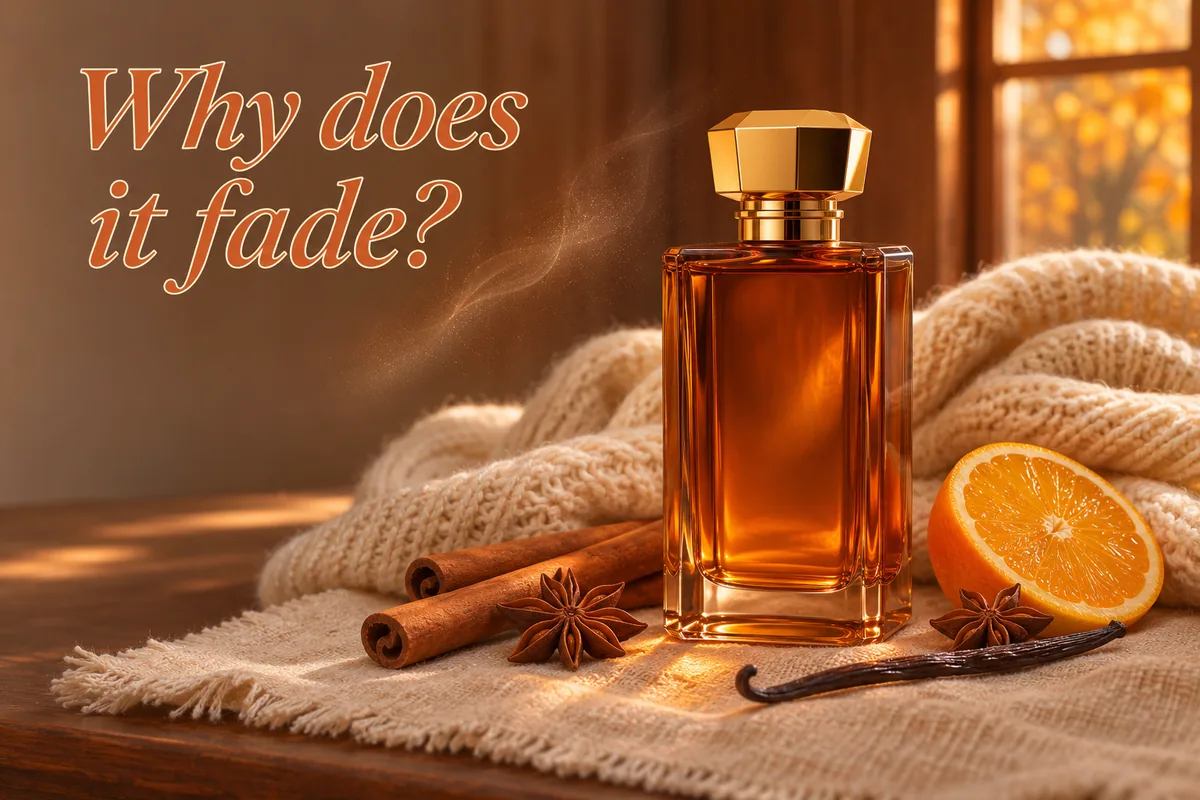
That is also why the length of time on a label is only a rough guide. One listing for the amber-and-vanilla eau de parfum in this article says it lasts about 12 hours. Buyers of the same bottle report something quite different from one another: one tested it and said it stayed for over six hours, another said a single spray lasted a full day, and a third said it faded after about thirty minutes. Skin, weather, how much you apply, and how long the bottle has been open all change the result, so judge a scent by how it behaves on you.
How should I apply fragrance so it lasts longer?
Most of the advice that actually works comes down to giving the scent something to hold on to and not wearing it off.
- Start with moisturized skin. Dry skin lets fragrance evaporate quickly. Apply right after a shower, on skin that has been moisturized with an unscented lotion, so you are not mixing scents.
- Spray where the skin is warm. The sides of the neck, the insides of the wrists, and the chest are common spots, because warmth helps a fragrance project. Spray from a few inches away so the mist spreads instead of soaking one spot.
- Do not rub your wrists together. Many fragrance fans say rubbing crushes the top notes and changes how the scent opens. Let it dry on its own.
- Use fabric carefully. Buyers say the scent clings to clothes for hours. Fragrance can stain or discolor delicate fabrics, so spray a hidden spot first or spray from farther away.
- Start with fewer sprays. One buyer said a single spray lasted all day, and another said that anyone used to lighter colognes will find it pretty strong. Sweet, dense scents project more than light citrus ones, so begin with one or two sprays and add only if needed.
Is it fine to layer a scented body lotion under it?
Yes, if you like the result. A vanilla body lotion under a vanilla perfume works because the two scents reinforce each other. If the lotion smells very different from the perfume, they will fight. A fragrance-free moisturizer is the safe default, and it is the better choice for anyone prone to irritation.
Why does the same perfume smell different on different people?
Skin type, body heat, diet, and even the weather change how a fragrance develops, which is why a scent that a friend wears beautifully can smell flat or sharp on you. That is the argument for trying a fragrance on your own skin and waiting for the dry-down rather than judging it from the bottle or a paper strip.
Buyers describe this process in their own words. One said the opening of a spicy-sweet amber scent smelled like sweet medicine, then settled into a pleasant vanilla. Another said the first spray took a little warming up before it became enjoyable. A third said the bottle smelled harsh when first opened and much better after sitting for roughly a month, a practice some fragrance enthusiasts call macerating. Treat that last one as one person's experience rather than an established rule. The practical takeaway is to give any new scent a full day of wear before deciding.
What if my skin reacts to perfume?
Fragrance is one of the common causes of skin sensitivity. The FDA notes that some people can react to components of fragrance formulas, that "unscented" products can still contain fragrance, and that the usual advice for people with a known sensitivity is to choose fragrance-free products and check ingredient lists (the agency's fragrance page explains this). If a perfume leaves a rash or itching on your skin, stop wearing it, and talk to a doctor if the reaction does not go away. Spraying on clothing rather than skin is one way to reduce contact, though it will not suit everyone.
What makes a warm, sweet fragrance work in cold weather?
Heavy, sweet fragrances built around vanilla, spice, amber, and wood tend to read as "cozy" in cool air, where a bright citrus can feel thin. Buyers of the amber-vanilla eau de parfum described exactly this: a cinnamon-and-orange opening that dries to warm vanilla, with some comparing it to baked goods or holiday potpourri, and several calling it a winter scent. Others warned that it can be too sweet for some noses. If you are not sure you like gourmand scents, which smell like desserts or baked goods, start with a small amount.
The listing also describes it as unisex, and buyers back that up in small ways: one said their husband and they liked it on each other, and a few mentioned compliments from people who asked what it was. Whether you want that depends on how much you want to be noticed. Sweet scents are rarely subtle.
Check what arrives. One buyer reported that a significant amount of the perfume leaked in transit, and a few said the packaging was not the best, even though others praised the box. Inspect the bottle and the cap when it arrives, and contact the seller quickly if there is leakage.
This second listing describes the same notes (spicy citrus and cinnamon, sweet vanilla, a woody and musky finish) and the same 12-hour claim, but it has no ratings or buyer feedback yet, so there is nothing to say about how it performs. Compare the seller, the box, and the bottle details with other listings before choosing.
Do I need a different scent for daytime and evening?
Not necessarily, but many people like having two: something lighter for work and daytime, and something richer for evenings and cold weather. A bright fruity-spiced scent with mango, ginger, jasmine, and cedar reads differently from a warm vanilla-and-spice one, and wearing the lighter one in the day can keep a heavy scent from feeling like too much.
Buyers of this set had few details to add: the few that left comments said it arrived in good condition and that they liked both bottles. Its description lists the amber-vanilla one as warm, creamy, and woody for evening, and the second as juicy and fresh for daytime.
How do I test a fragrance without wasting money?
- Wear it on your skin for a full day, not just a few minutes. The first ten minutes tell you very little about the dry-down.
- Try one scent at a time. Testing several in a row on the same skin only confuses your nose.
- Look for a sample, a travel size, or a return policy before committing to a 100 ml bottle.
- Note what you were wearing and how warm the day was. Heat makes a sweet scent louder.
How should I store perfume so it keeps?
Heat, light, and humidity are what shorten a bottle's life. A dresser drawer or closet shelf is better than a windowsill or a steamy bathroom, and the original box protects against light. Keep the cap on tight, and do not store it in a hot car.