In this article
An indoor cat still has a hunter's instincts. When nothing gives them an outlet, they come out as 5 a.m. sprints, shredded paper towels, and nonstop meowing while you are trying to work. You do not need to hold a wand all day to fix that. A short routine you can keep, plus a toy that moves on its own for the hours you cannot play, covers most of it. Here is how to set that up, where to mount a toy so it stays put, and what to check before you leave a cat alone with it.
Why does my indoor cat get so restless?
Cats are built to stalk, chase, pounce, and catch, in short bursts, several times a day. An apartment or house gives them very little of that. So the energy goes somewhere else: a 5 a.m. sprint down the hallway, paper towels shredded off the roll, ankles ambushed, or a cat that follows you from room to room asking for attention you cannot give while you are on a call. Buyers of the toys below describe exactly these situations: a kitten that rampaged through the house during meetings, a cat that stopped yowling once she had something to chase, a senior cat that perked up again.
None of that means you are doing something wrong. It means the cat has hunting energy and no outlet. The fix is rarely one big gesture. It is a small routine you can keep, plus something that moves on its own for the hours when you cannot be the one holding the wand. (If your cat suddenly changes how much it eats, sleeps, or plays, talk to your veterinarian rather than assuming boredom.)
How much play does a cat need?
There is no magic number, and kittens and adult cats differ. A routine that works for a busy household is two or three short sessions a day, one before a meal and one in the evening, when many cats are most active. What matters most is how a session ends. A wand game that just stops leaves a cat keyed up with nothing to show for it. The American Animal Hospital Association suggests slowing the toy down toward the end so the cat can catch its "prey," then offering a treat to complete the hunt. Treat that as the ending to aim for every time.
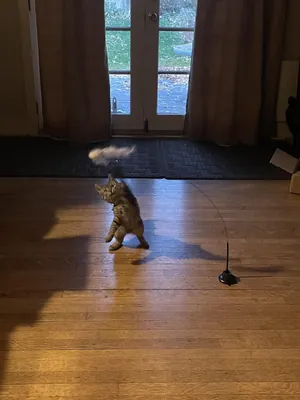
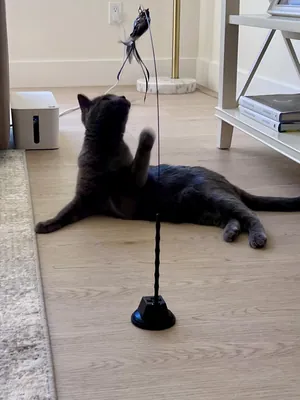
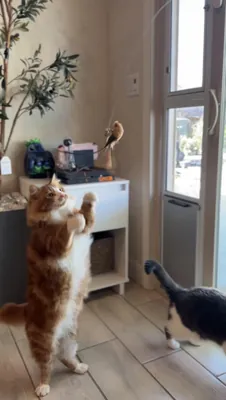
What kind of toy can keep a cat busy when no one is holding it?
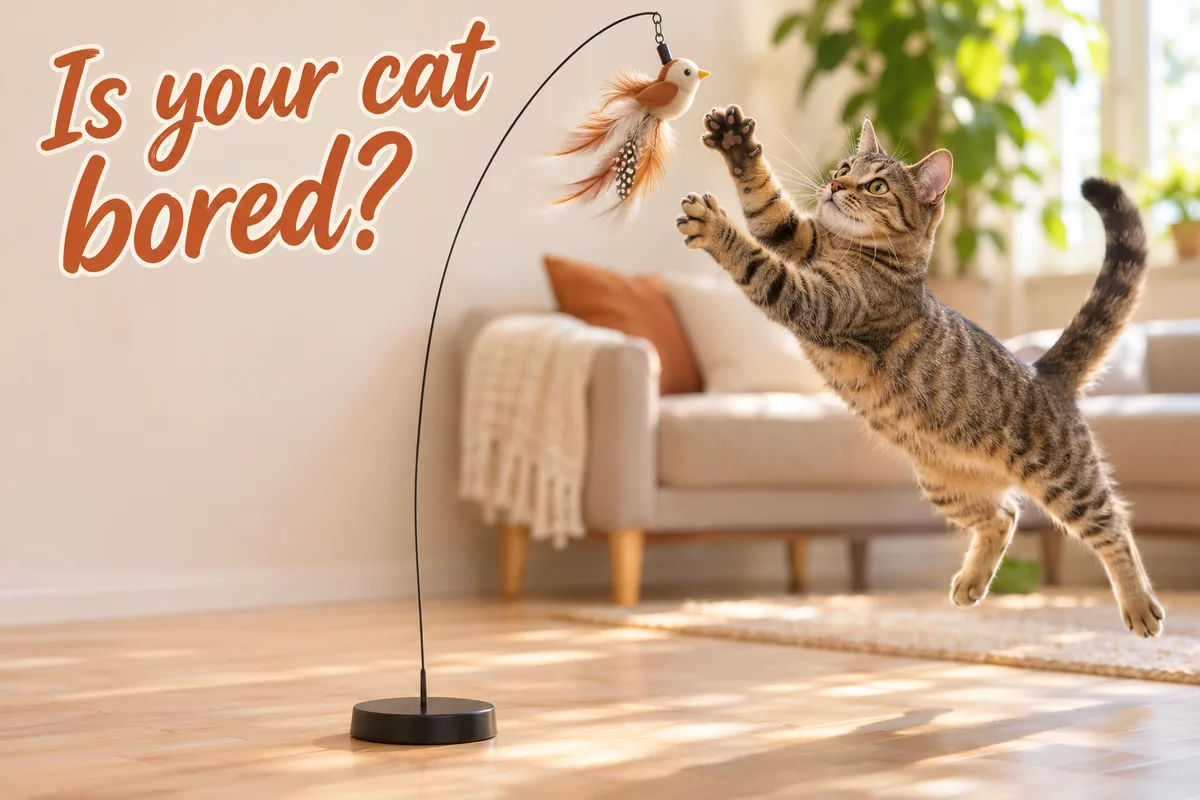
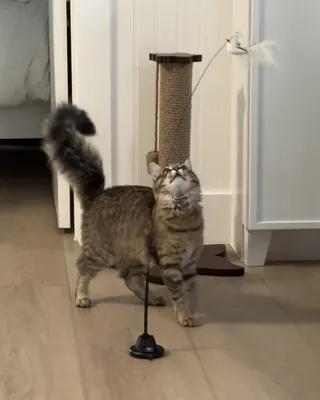
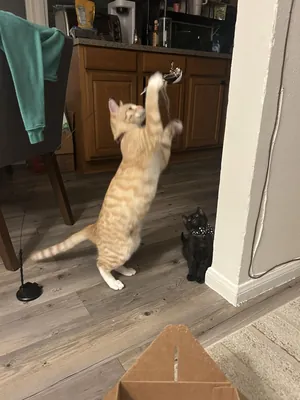
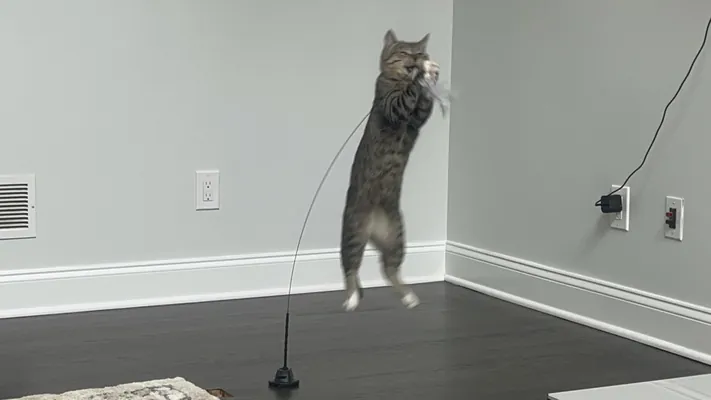
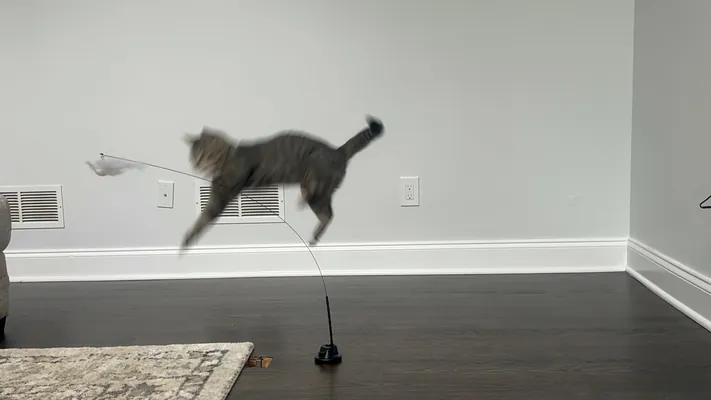
Four kinds of toy do some of the work for you, and they suit different cats. The first needs no power at all: a flexible wire on a suction base springs back every time the cat swats the bird. The second is a motorized wand that rotates on its own. The third hangs from a door frame or the ceiling and moves up and down. The fourth is a small plush bird that flaps when the cat touches it. Each has trade-offs, and the sections below take them one at a time.
Do I need batteries for a toy to be fun?
Not necessarily. A spring-and-wire toy gets all its movement from the cat, so it is silent apart from a small bell and never runs out of charge. Buyers of this style mention that it works with no involvement from them, that it holds on hardwood and tile, and that a cat will keep batting the loose birds around even when they are not attached. One buyer with a lazy kitten found the bird had to be lowered by hand before the cat took an interest; another said a nine-month-old kitten was worn out after about twenty minutes.
What if my cat gets bored of it after a day?
This is the most common reason a toy ends up in a drawer. Cats lose interest in anything that never changes. Buyers handled it in a few ways that cost nothing: swapping the bird for a different attachment, putting the toy away for a couple of days and bringing it back, and moving it to the room where the household spends its evenings. One buyer said the cat ignored it for the first few days, then went wild once the toy moved next to the family couch. A toy only works if the cat can see people near it.
Is a motorized wand worth it for a high-energy cat?
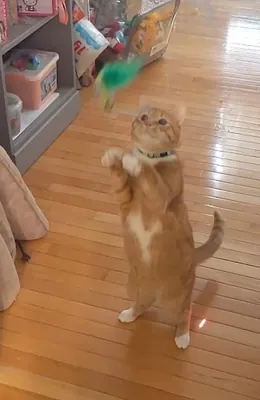
Motorized wands move in a changing circle, with the feather rising and falling, which is closer to how a wand handled by a person behaves. Buyers say the unpredictable path is the point: one said it even got an 11-year-old cat off the couch, others bought a second unit so two cats could play at once. The listings describe a touch-activated cycle of roughly eight to ten minutes followed by a built-in rest, then a restart when the cat taps or tugs the toy. That timer matters for a cat home alone, because it avoids nonstop overstimulation.
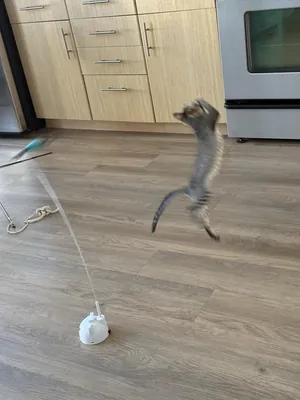
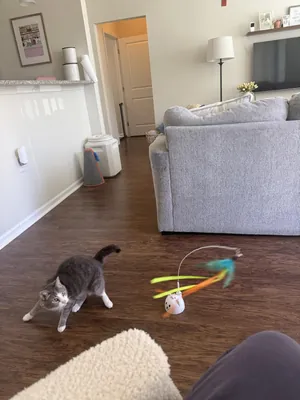
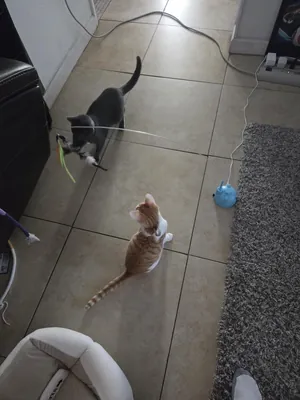
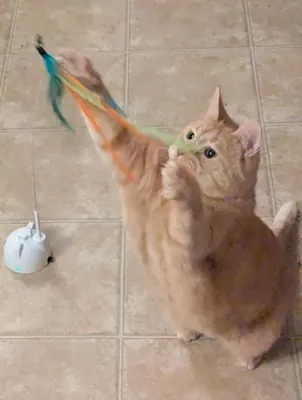
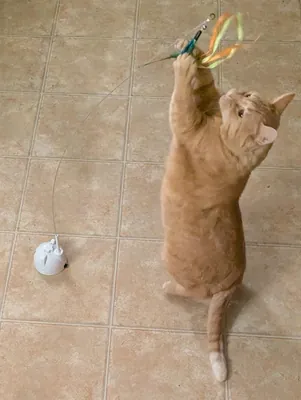
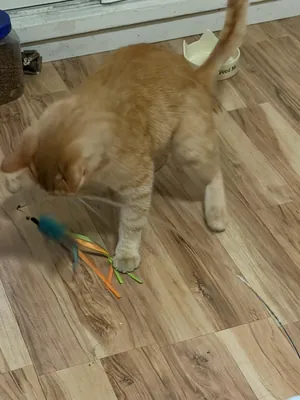
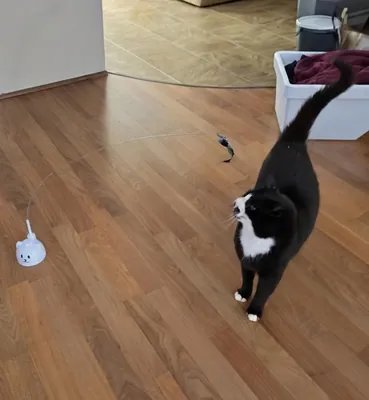
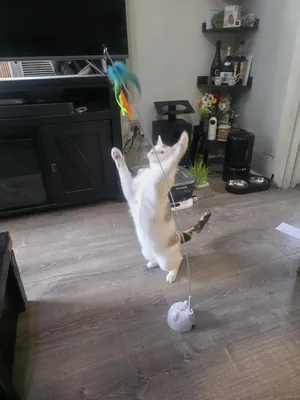
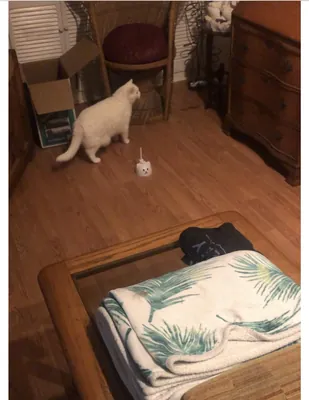
Check the details before you buy any motorized wand. A few buyers reported that the post holding the wand snapped or loosened after one to two months of rough play, and that the part could not be replaced. Others had no trouble. The listing describes the base as washable and reusable, so rinse it when it stops gripping and let it dry fully before pressing it down again.
Where do I put it so it stays put?
Most of these toys stick down with suction or a sticky pad, so the surface decides how well they work. Listings recommend clean, smooth, flat surfaces such as glass, tile, sealed wood, and marble. Buyers back that up: the bases held on tile and hardwood and on a sliding glass door and window, but they would not hold on carpet.
A number of buyers solved the carpet problem the same way: they set the base on a thin, flat board, an old tile, or a serving plate, which gives the toy a hard surface to stick to and a wider footprint so a heavy cat does not tip it. If you have a rug, a flat piece of plywood or tile is worth trying before you give up on the toy.
Protect your surfaces too. One buyer reported that pulling a strongly stuck base off a floor took varnish with it, and another had paint come off a wall. Before committing to a spot, test the adhesive in a small hidden area, and release the base slowly rather than yanking it.
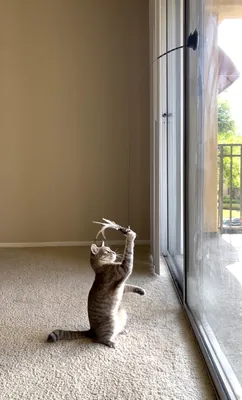
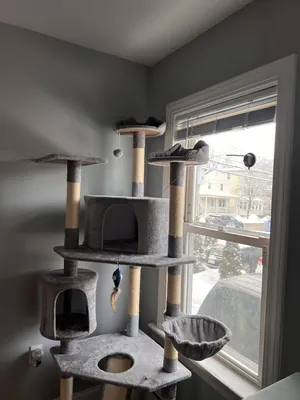
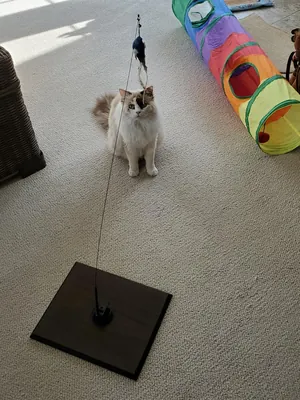
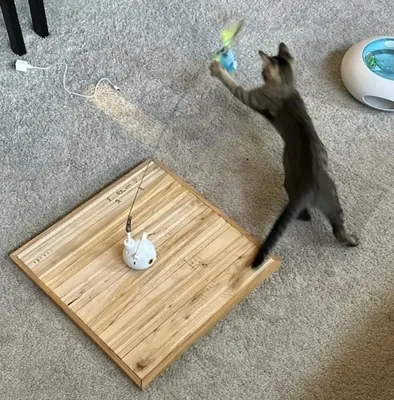
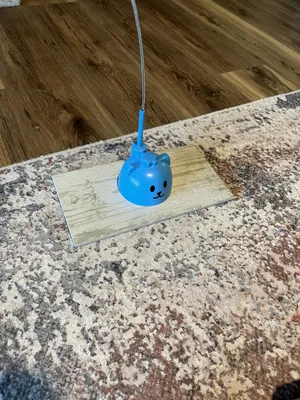
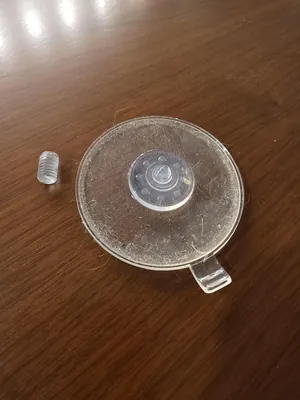
Mixed experiences are worth knowing here. Several buyers said this base stuck very well, while one reported it would not stay on glass, plastic, wood, or tile at all. Treat the adhesive as the part most likely to vary with your floor.
Why does the wand bend or break, and can I make it last?
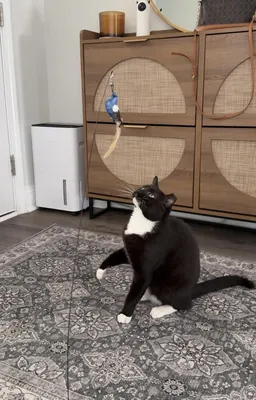
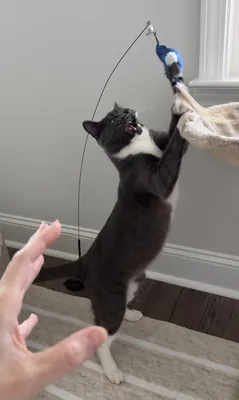
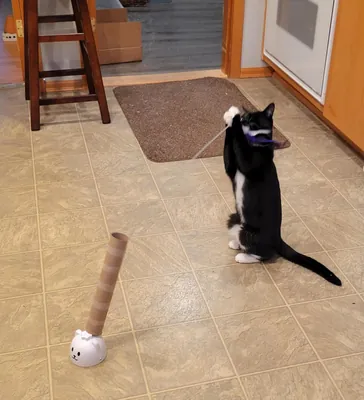
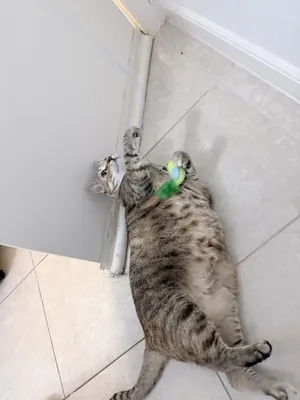
Rotating wands share one weak point: the thin rod where it meets the base. Cats that grab the bird and lie on it can bend the rod at the base, and several buyers across different models said the wand snapped or sagged within weeks. One buyer slipped an empty paper-towel tube over the base of the rod to keep it from bending (one of the photos above shows a similar setup). That is a household workaround, not something the seller recommends, and a loose tube can itself be chewed, so keep an eye on it. A more reliable habit is to turn the toy off when you are not around if your cat is the grab-and-wrestle type.
Buyers of this one gave it high marks for hours of chasing, and a few reported the rod bending or the motor failing after several months. One said the distributor replaced a broken unit for free, so keep your order information handy.
Can I use a doorway or ceiling instead of the floor?
If floor space is tight, or your cat is more of a jumper than a chaser, hang the toy overhead. These toys stick to a door frame or ceiling with adhesive, dangle a bird or mouse on a thin cord, and tug it up and down in a random pattern. Buyers have hung them in hallways, in a bathroom doorway, from a ceiling fan housing, and from the ceiling itself. Two things to confirm before you stick one up: the adhesive needs a smooth, clean surface, and the cord needs to hang where a cat cannot get tangled in it.
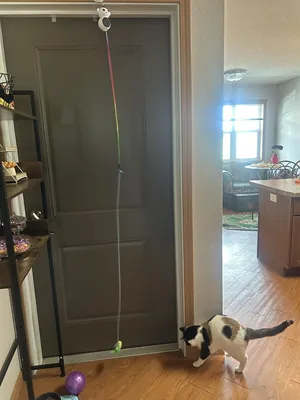
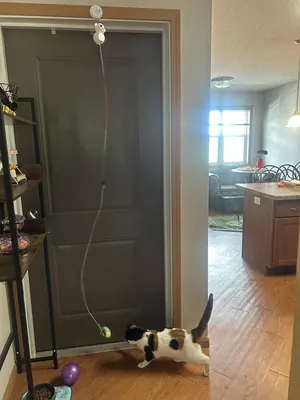
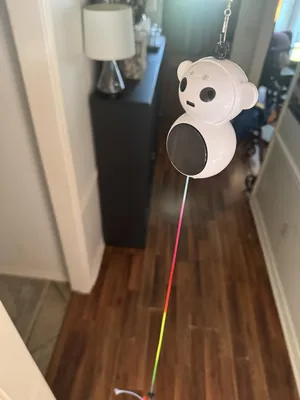
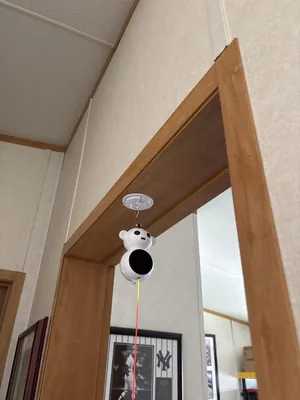
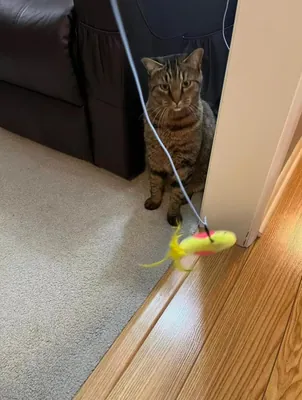
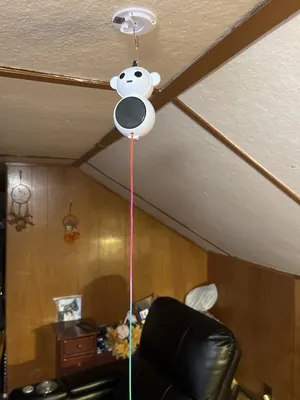
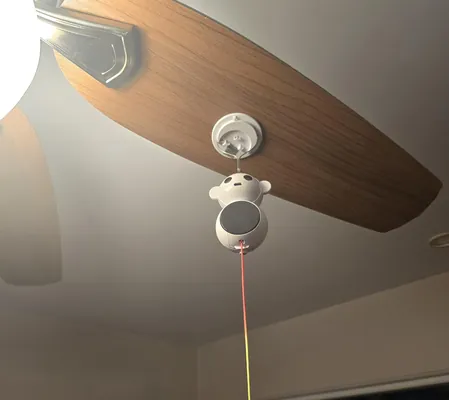
Buyers said it hangs on frames of different widths, includes spare attachments, and that the movement is erratic enough to hold attention. Not every cat stayed interested: one household said two cats lost interest within a few hours, and another said the bird only goes up and down, which did not challenge an older cat.
Are laser pointers okay for cats?
Several of these toys include a laser, so it is worth being clear about the downside. A review of cat behavior research notes that laser-light play alone does not let a cat finish the hunting sequence, and that this may trigger frustration and stress, though the findings are correlational. Behaviorists commonly advise following any light-beam game with a treat or a toy the cat can actually catch. The practical version: keep the laser sessions short, never shine it at the cat's face, and if the toy lets you switch the laser off, do that and let the cat chase the bird or mouse, which it can actually grab. Several buyers did exactly that, and one buyer was uneasy about aiming a laser near a kitten's eyes.
This one is described by its listing as running an eight-minute session, then waiting in standby until the cat taps it or pulls the string. Buyers noted one cat chasing the laser while the other went for the dangling bird, a 13-year-old and a senior cat getting active again, and a heavy cat that needed a motion-activated option at night. One buyer would not let a kitten use it unsupervised because of a worry about cord entanglement.
What if my cat prefers to grab and kick instead of chase?
Some cats are not chasers at all. They are grabbers and kickers. For them, a plush bird that flaps and chirps when touched gives a way to wrestle prey without any wand at all. Buyers describe cats carrying the bird across the room like a kill, hugging it, rolling with it, and in a few cases falling asleep next to it. A few things to expect: the toy flaps in place and does not fly, the chirp can be repetitive, and soft parts like legs and tail feathers can get pulled off by an enthusiastic cat.
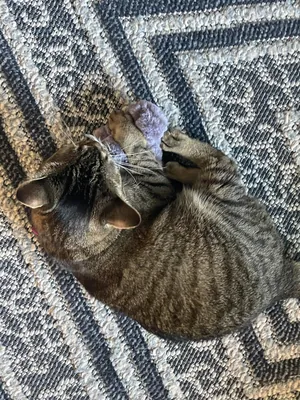
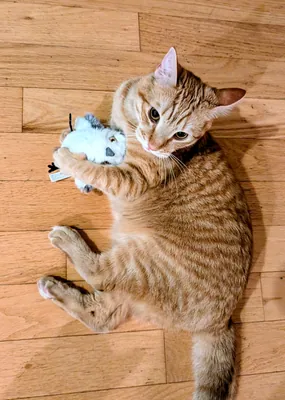
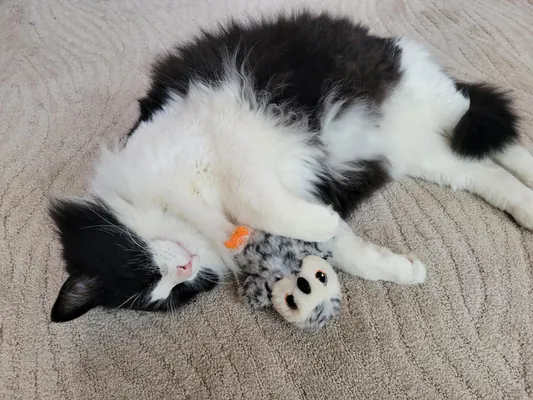
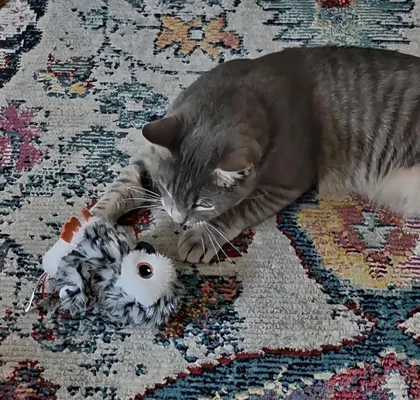
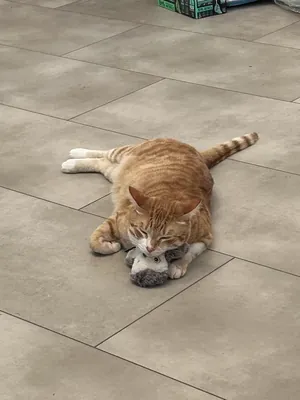
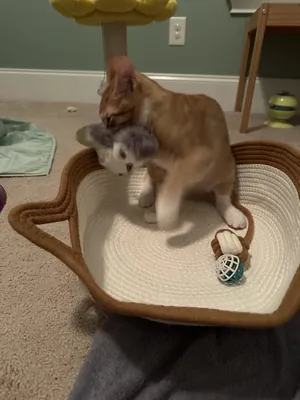
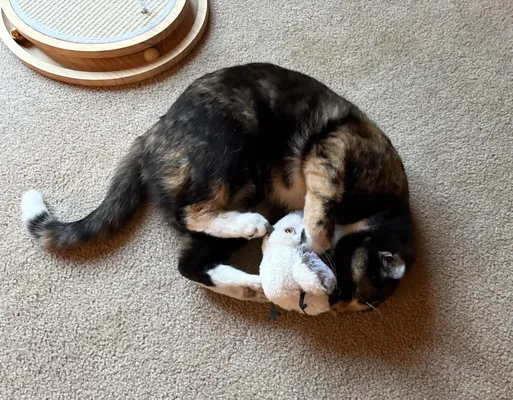
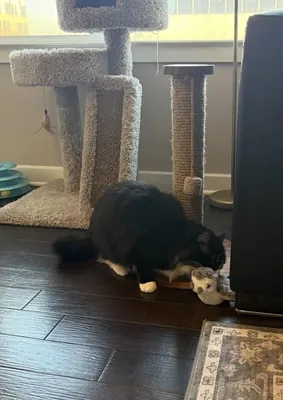
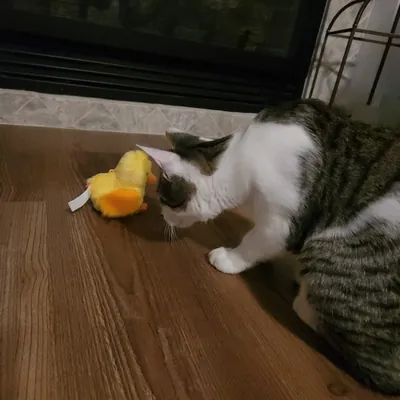
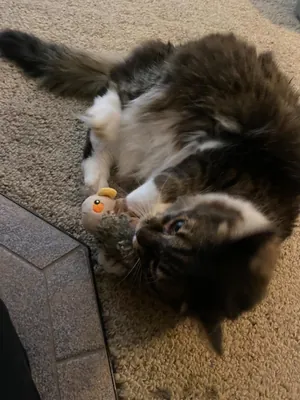
Buyers in this group praised battery life that lasted days between charges, a toy that stays still until touched, and cats that finally played after ignoring everything else. One noted it does not fly like the demonstration video, and a few said the chirp bothered them more than the cat.
A buyer whose cat was grieving the loss of a companion said this was the first toy that got her moving again. Others found it louder than expected, and one reported the on/off switch broke after a couple of uses. The listing says to remove the motor before washing the plush.
Is it safe to leave a cat alone with an automatic toy?
Mostly, if you pick the right toy and set it up carefully. Start with supervised sessions to see how your cat treats it. Some cats ignore a toy, some wrestle it to the floor, and a few chew the attachments.
- Strings, ribbon, and thread are the main hazard. A cat that swallows them can end up with a serious intestinal problem, and veterinary advice is not to pull on anything hanging out of the cat but to call a vet right away. Take off dangling cords and streamers before leaving the room, or switch the toy off when you are not there.
- Feathers and small attachments get torn off sooner than you expect. Some buyers wrote that feathers were gone within a day or two. Check attachments for wear and replace them before they come apart.
- Keep hanging cords short or out of reach of a cat that might get tangled, and avoid hanging a toy over a place where a cat could jump into it.
- Choose the lowest speed first with kittens, older cats, and cautious cats. Listing descriptions include timers that pause or shut off, which can help when you are out.
What about older, shy, or multi-cat homes?
Older cats often watch before they play. Buyers with senior cats say the cat sat and observed the toy for a while, then started batting at it. Move the toy to where the cat naturally rests, and use a slow speed. A shy cat may need a few days to approach it; leave the toy in place and turn it on while you are in the room.
In a home with more than one cat, jealousy is the usual problem. One buyer bought a second toy so two cats could play at once; another found one cat was scared of a fast-swinging bird and got hit by it. If your cats are different ages or temperaments, two toys in different rooms is easier than sharing one.
Whatever you choose, keep the live play. A toy that moves on its own fills the quiet hours, but a short wand session with you, ending with a catch and a treat, is still what teaches a cat that the hunt has a happy ending.