In this article
When it rains for a week or the temperature drops, a parent's job gets harder: kids still need to move, and the living room is the only gym. The CDC recommends at least an hour of activity a day for children ages 6 to 17, and most kids do not get it. This guide covers what counts as activity, how to set up safe indoor play, where wall-projection target games fit in, and what to check before you set one up.
How much activity do kids need, and what counts?
The CDC recommends that children and teens ages 6 to 17 get at least 60 minutes of moderate-to-vigorous activity a day. Most of it should be aerobic, with vigorous effort on at least three days a week, plus muscle- and bone-strengthening activity such as climbing, jumping or push-ups on at least three days (CDC).
The CDC's simple intensity check is the talk test. At a moderate pace a child can talk but not sing. At a vigorous pace they can say only a few words before taking a breath (CDC).
Few children get there. The CDC says only about one in four kids aged 6 to 17 gets 60 minutes of activity every day (CDC). On a rainy day or a freezing week, that gap gets wider, because the usual places to run are closed. The question for a parent is how to fill the hour indoors without turning the living room into a hazard.
How do you make indoor play safe and active in a small home?
Start with the room, not the toy. Clear a lane or an open patch of floor, move glass and sharp furniture corners out of the way, and pick a wall that can serve as a target. A plain, light-colored wall with a few feet of clear floor in front of it is all that most indoor games need.
Then set ground rules before anything turns on. CPSC recommends setting ground rules for play and supervising young children closely (CPSC). A few rules that fit any aim-and-move game: only aim at the wall or target, never at a person's face, take turns so no one stands in the line of play, and stop when someone says stop.
Then, mix games. A single projector game will not carry a whole afternoon, and it will not give the vigorous effort the CDC mentions on its own. Pair it with something that gets the heart rate up: a few minutes of dance, jumping, or an obstacle course between rounds.
Can a wall-projection game count as active play?
Partly. These games ask a child to stand, aim, move to a new spot and react, which is more movement than a screen, and several are built for two players taking turns. They are not a replacement for running and jumping. Think of them as a light-to-moderate activity that makes a good break between harder bursts, and one that gets kids off the couch when they would otherwise be on a tablet.
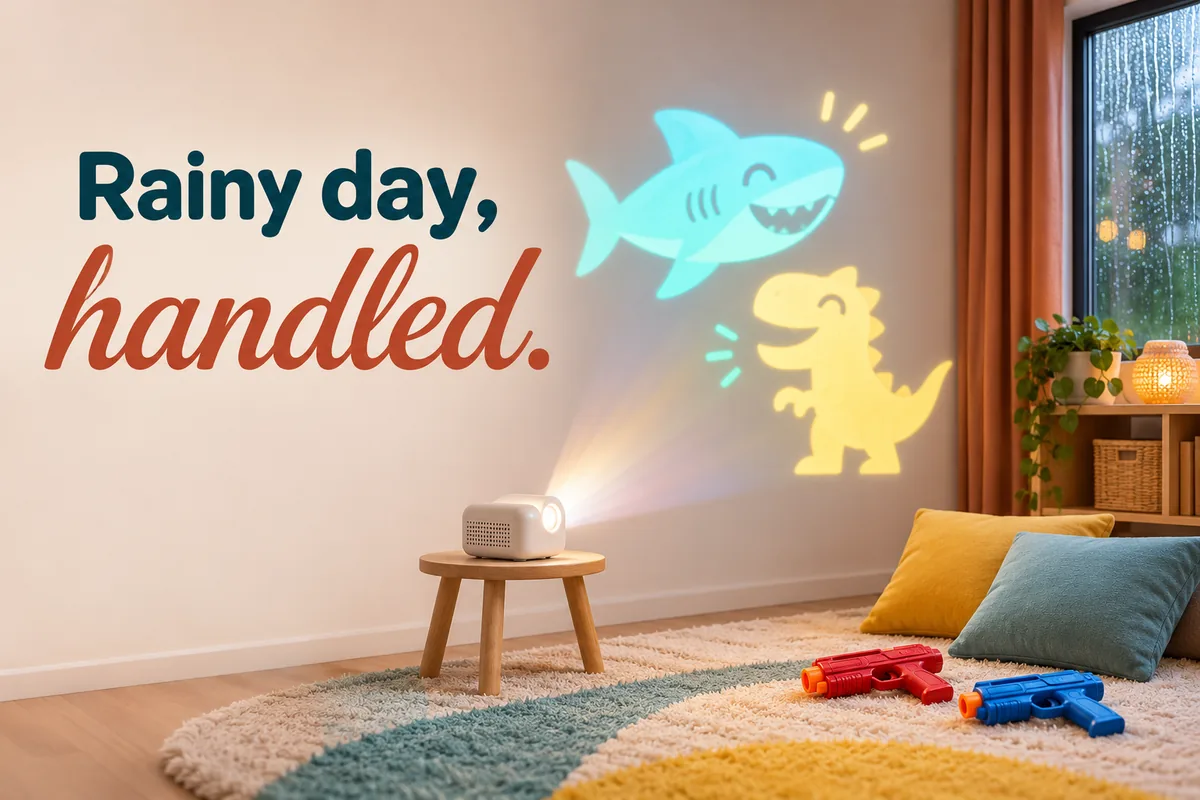
Two types are on offer. One works like shadow boxing: the projector casts a ninja figure on a wall and the child tries to land hits with a hand-held puncher before the figure strikes back. The other is a tag or target style: a projector throws target images on a blank wall and infrared blasters score the hits. Listings for these describe slides with shark, dinosaur, penguin, robot or duck targets, a digital display for scoring, lights and sound.
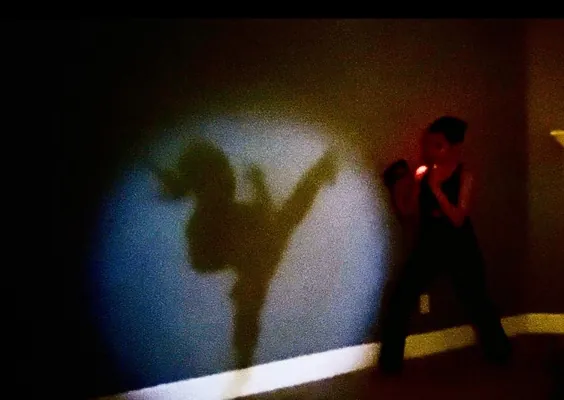
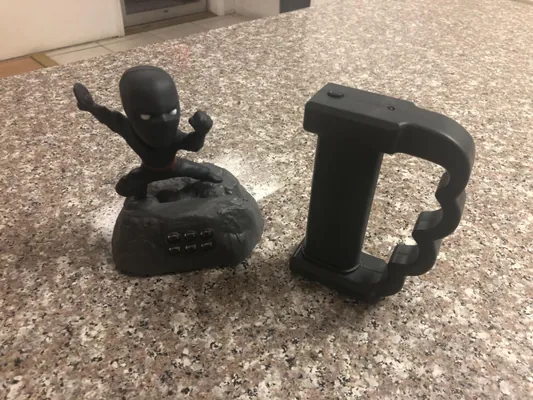
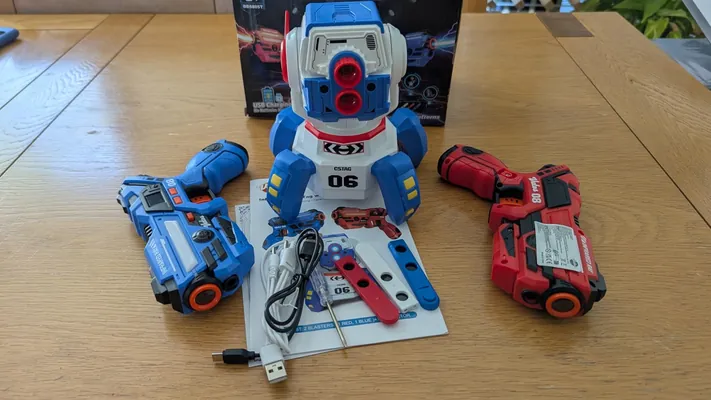
Buyers report that kids enjoyed competing against the ninja figure, that practice mode helps them get the hang of it, and that the game works as exercise for the family. A buyer of the rechargeable tag set likes that it is not a game of shooting each other and that adults enjoy it too, but warns that it needs a biggish blank wall and is more fun in a house with room.
What should you check before you set one up?
- The wall. The listings call for a plain wall and a dimmer room. A busy or dark wall washes out the targets.
- The distance. One listing gives 1 to 1.3 meters from the wall to the projector. That sets how much floor you need, plus room for players to stand.
- Power. Some use AA batteries (four or five), others recharge by USB. Stock spare batteries, or plan to charge before game night.
- The blasters. At least two listings describe infrared blasters rather than projectiles, which is what you want in a living room. Look for a bright color, because CPSC advises that toy guns be brightly colored so they are not mistaken for a real one (CPSC). Keep the house rule about faces.
- Noise. Lights and sound effects are part of the appeal and can also be a lot in a small apartment. Check for a volume control.
Also consider the rest of the afternoon. A game that scores itself is good for a parent who wants to join in without refereeing, and a pair of blasters or controllers means siblings can share rather than argue over a single one.
What else gets kids moving indoors?
A projector game is one piece. A simple rotation works better than any single toy: ten minutes of the target game, five minutes of something that raises the heart rate, then a different game. Tape a hopscotch course to the floor. Put on music and have a dance freeze game. Build a pillow obstacle course. Use stairs for climbing practice if you can supervise them.
Use the talk test as a guide. If a child can still sing, bump up the pace. If they can only say a few words, they are working at the vigorous level the CDC wants to see on at least three days a week (CDC).